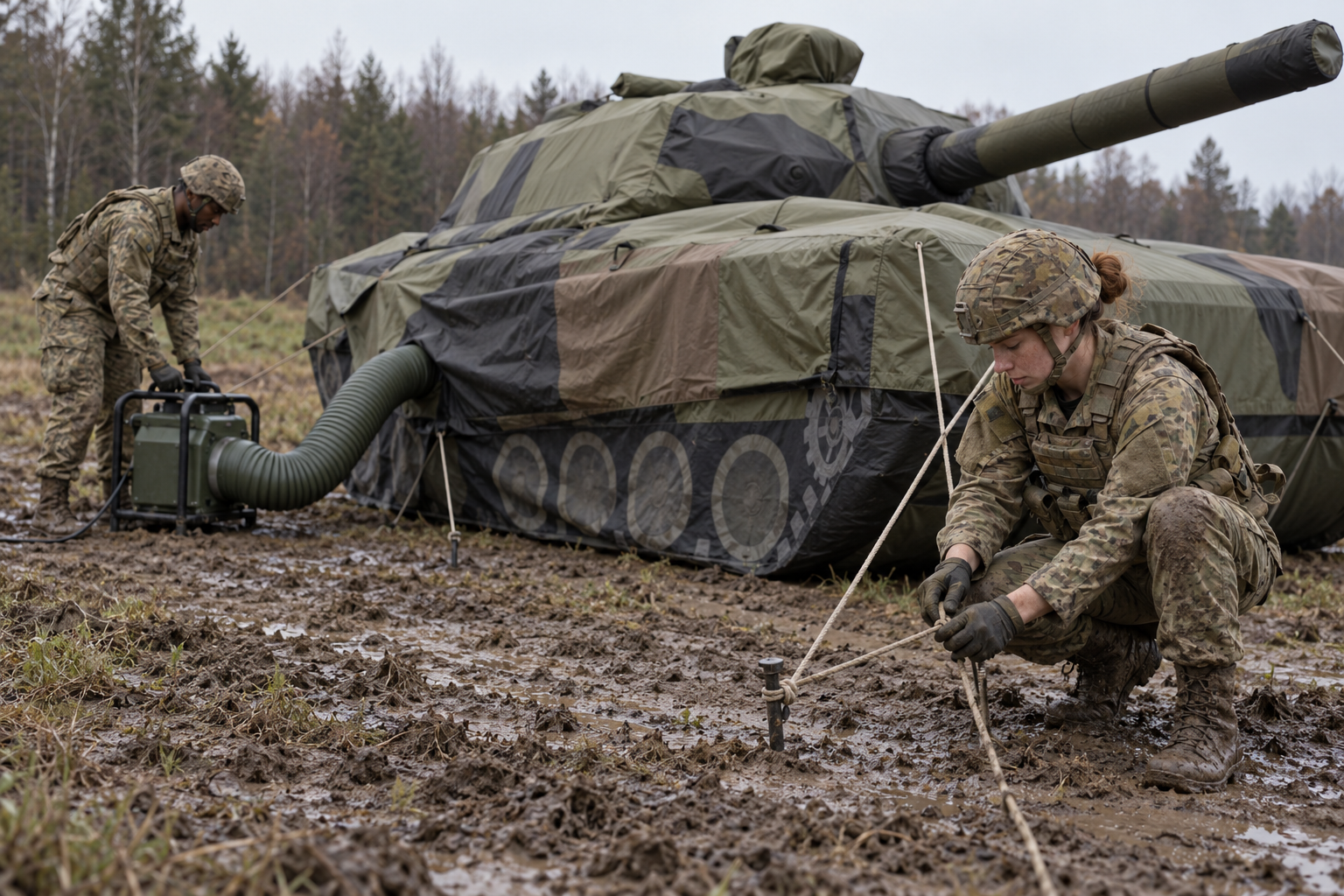
In short: Decoys work because modern targeting is expensive and sensors are imperfect. An inflatable or wooden copy that costs a tiny fraction of the real system can absorb a precision strike, waste a launcher’s limited ammunition and distort the enemy’s battle damage count. The catch is that a good decoy has to fool radar and thermal cameras as well as the human eye.
Most people picture military deception as something from the Second World War. Rubber tanks, painted canvas, actors on the radio. It sounds quaint. It is not. Every war of the last 30 years has shown the same pattern: as weapons get more precise, fake targets get more valuable.
Read also: Stealth does not make an aircraft invisible. It shortens the defender’s clock · Air defence rarely fails on accuracy. It fails when the magazine runs empty · A warship’s real enemy is the horizon, not the missile
Why precision makes decoys stronger, not weaker
A precision-guided munition will hit exactly what it was pointed at. That is the weakness. The weapon is only as smart as the targeting decision behind it, and that decision is made from a drone feed, a satellite image or a radar return, often in minutes.
If the thing in the picture is a fake, the strike still succeeds technically. The munition is gone. So is the launcher’s time.
Short supply of munitions makes this worse for the attacker. A rocket artillery battery carries a limited number of rounds per load, and every reload means driving to a resupply point and exposing the launcher. Spending one load on a plywood copy is a real loss.
Three wars, one lesson
- 1944, Western Europe: the US Army’s “Ghost Army”, roughly 1,100 men, used inflatable tanks, recorded sound effects and fake radio traffic to impersonate much larger formations.
- 1999, Kosovo: Serbian forces used decoy vehicles and fake positions under NATO’s air campaign. Post-war reporting, most famously by Newsweek in 2000, found evidence of only 14 destroyed tanks against wartime claims of around 120.
- 2022 onward, Ukraine: Western media reported Ukrainian wooden copies of HIMARS launchers drawing Russian strikes, while Russian officials claimed to have destroyed more HIMARS than had been delivered.
- Today: several European firms sell inflatable replicas of tanks, air defence systems and aircraft as standard catalogue items.
Fooling the eye is the easy part
A drone operator looking at a daylight camera can be fooled by shape and colour. Modern sensors look for more. A running tank engine glows on thermal imaging. A metal vehicle reflects radar strongly. An inflatable sitting cold in a field shows up as exactly what it is.
That is why serious decoys are now multispectral. Heated panels imitate the engine deck. Metallised fabric or corner reflectors give a radar return close to a real vehicle. Some systems add emitters that imitate the radio signature of a command post, which ties deception directly to electronic warfare.
The counter: watch behaviour, not shapes
Decoys have one stubborn weakness. They do not live. A real battery moves after firing, receives fuel, leaves track marks and generates radio chatter. A fake one sits still. Persistent surveillance, especially from loitering munitions that can watch a target before committing, gives the attacker time to spot that difference.
Defenders answer by moving decoys, adding tracks with real vehicles, and mixing fakes with real units so that watching one does not reveal the other. For the broader doctrine behind this, see the overview of military deception on Wikipedia.
When you read a claim that a specific number of launchers or tanks was destroyed, ask one question first: who confirmed the wreck on the ground? Until someone has, treat the number as a count of strikes, not of kills.
More articles you may like
- Stealth does not make an aircraft invisible. It shortens the defender’s clock
- Air defence rarely fails on accuracy. It fails when the magazine runs empty
- A warship’s real enemy is the horizon, not the missile
- The battle you cannot see: how electronic warfare decides who wins first
- Loitering munitions: the weapon that waits before it strikes
- Precision-Guided Munitions: What “Smart” Weapons Actually Buy on the Battlefield