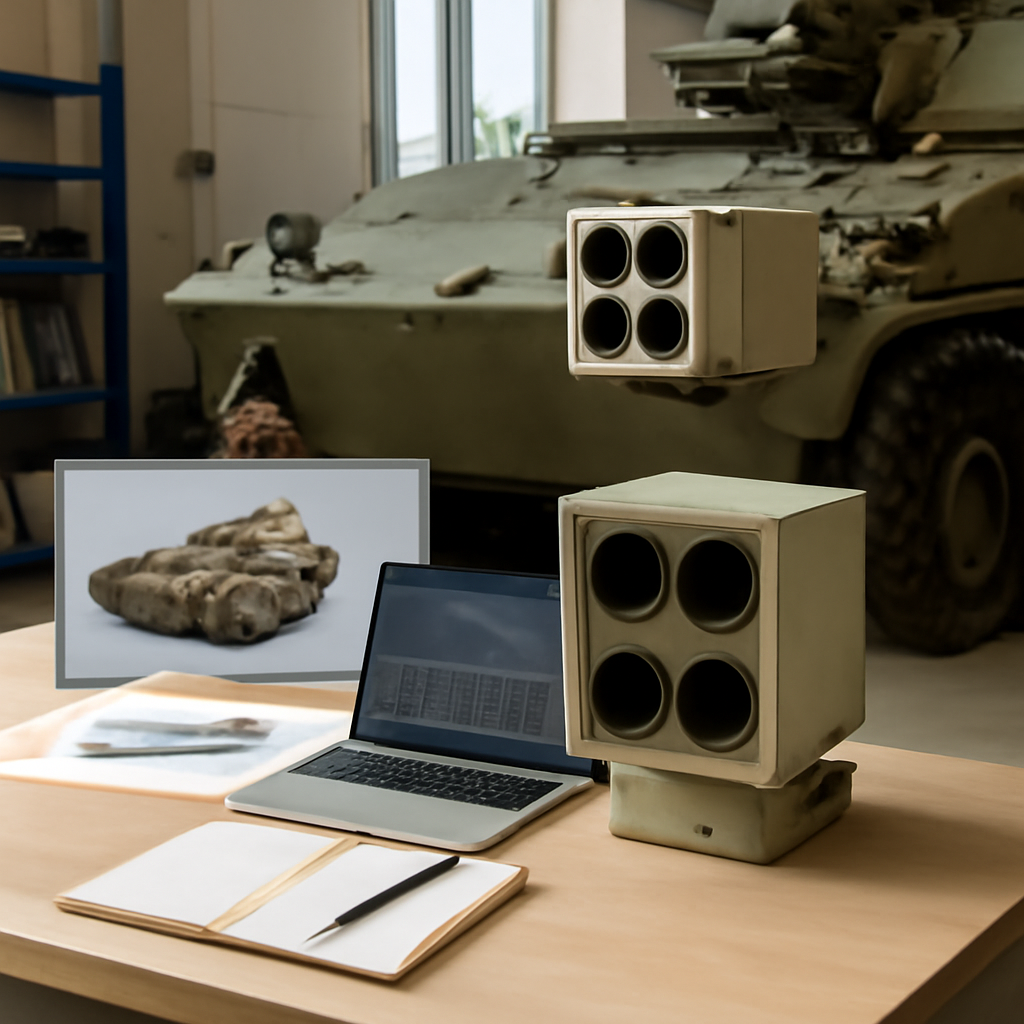
In short: modern tanks no longer beat threats by adding steel. Active protection systems detect an incoming rocket or missile and shoot it down or throw it off course in milliseconds. Interception now decides who survives on the battlefield.
For most of the twentieth century the logic was simple. A bigger threat meant more plate, more weight, more fuel burned to move it. That arms race stopped making sense once a single infantryman with a shoulder-launched rocket could punch through the front of a 60-ton tank. You cannot bolt on enough steel to stop a modern shaped-charge warhead without building something too heavy to drive.
קראו גם: Keep Your Car Battery Alive Longer: A Practical Maintenance Guide · Protecting Armored Vehicles · Israel’s Iron Dome – A missile killing war machine
So the answer moved. Instead of absorbing the hit, the vehicle now tries to stop the projectile before it arrives. Radar and sensors watch every angle, a computer calculates the intercept, and a countermeasure fires. This is the core idea behind an active protection system, and it has quietly rewritten how armored vehicles are designed.
Hard-kill versus soft-kill
There are two families. Soft-kill systems try to confuse the incoming weapon: they jam its guidance, blind its seeker with infrared jammers, or spew smoke and chaff so the missile loses the target. Nothing physically hits the threat. Hard-kill systems are blunter. They launch a projectile or explosive charge that strikes the incoming round and destroys it in flight, sometimes at a distance of only a few meters from the hull.
The timing is brutal. A rocket-propelled grenade closes the last 30 meters in well under a tenth of a second, so the whole detect-decide-fire loop has to finish faster than a human blink. Radars scan continuously, and the fire signal goes out automatically. No crew member is fast enough to be in that loop.
The systems that proved it works
Israel’s Trophy, built by Rafael, is the reference case. Fitted to Merkava tanks and later to Namer carriers, it intercepts rockets and anti-tank missiles with a burst of explosively formed projectiles fired from launchers on the turret sides. The US Army adopted Trophy for its M1 Abrams after trials, which tells you how seriously it is taken.
- Trophy (Israel): hard-kill, radar-cued, on Merkava, Namer and M1 Abrams.
- Iron Fist (Israel): lighter hard-kill using a blast charge instead of fragments.
- Arena and Afghanit (Russia): turret-mounted interceptors, Afghanit fitted to the T-14 Armata.
- Drozd: the 1980s Soviet pioneer that first put the concept on a tank.
- Quick Kill (US): a vertical-launch design intended to defend all directions at once.
How the layers stack up
No serious army treats interception as the only defense. It sits on top of passive armor and reactive tiles, catching what those layers cannot. The point is division of labor: passive armor handles fragments and small arms, reactive armor disrupts a shaped-charge jet, and the active system deals with the guided or shoulder-fired threats that would otherwise defeat both.
The same math as air defense
The idea is not new to anyone who follows air defense. Shooting down a threat instead of hardening against it is exactly the logic used against surface to air missiles and against the short-range rockets that systems like Iron Dome are built to catch. Scaled down to a vehicle, the engagement window shrinks from seconds to milliseconds and the interceptor sits meters away rather than kilometers, but the principle holds. Detect, track, kill before impact.
There are limits worth naming. Hard-kill charges throw fragments, which is dangerous for nearby infantry, so dismounted troops have to keep their distance. Every system carries a fixed number of countermeasures, and a coordinated salvo can try to swamp them. Top-attack missiles that dive from above are harder to catch than a flat-trajectory rocket. Designers know all of this, which is why active protection is added to armor rather than swapped for it.
Source: Active protection system on Wikipedia.