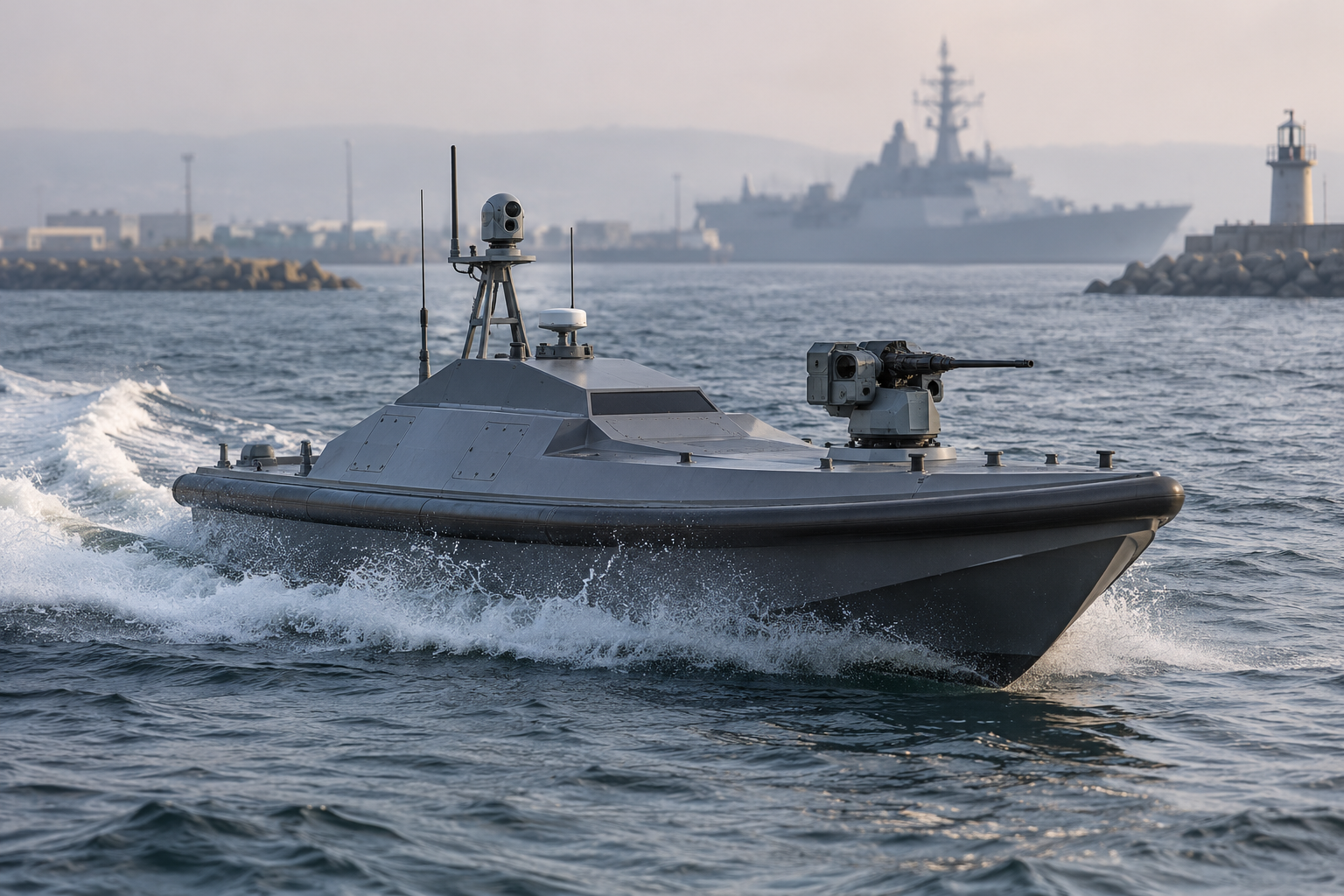
In short: Rafael’s Protector was built so that a remote-controlled boat, not a crew, gets close to a vessel that might be a bomb. It entered service in the 2000s as the first operational armed unmanned surface vehicle. Its value is distance: the operator decides from safety while the hull takes the risk.
Navies have long assumed that harbour security means sailors in fast boats. Someone has to pull up beside the fishing skiff that ignored the radio call. Someone has to look inside.
Read also: In a modern dogfight, the jet no longer has to point at the enemy · The cheapest weapon on the battlefield is a tank that does not exist · Stealth does not make an aircraft invisible. It shortens the defender’s clock
The Protector questions that assumption. Why send people at all?
The attack that shaped the design
In October 2000 a small boat packed with explosives came alongside the destroyer USS Cole in Aden and detonated, killing 17 sailors. The attackers needed no navy of their own. They only needed to get close.
Rafael developed the Protector as a direct answer to that kind of threat. The first version was based on a 9-metre rigid-hulled inflatable boat, with a deep V planing hull and a single diesel engine driving water jets to roughly 50 knots. In 2012 the company announced a larger 11-metre model with more range and room for more weapons.
What sits on the hull
The weapon is a Mini Typhoon stabilised remote weapon station, which keeps a machine gun on target while the boat pitches in the swell. Above it sits the Toplite electro-optical turret, with thermal imaging, day cameras and a laser rangefinder. There is also a loudspeaker, because most encounters end with a warning, not a shot.
A commander and an operator control the boat from shore or from a mother ship. The person deciding whether to fire is never the person sitting next to a possible bomb.
Where it has actually worked
The Republic of Singapore Navy took the Protector to the northern Persian Gulf in 2005, operating it from its Endurance-class landing ships. It ran surveillance and force-protection sorties of more than eight hours at a time. Singapore later used it for anti-piracy duty in the Gulf of Aden.
That record matters for a simple reason. Unmanned boats were a concept for years before anyone sailed one under real rules of engagement.
The limits nobody puts in the brochure
A remote boat is only as good as the link back to its operator. If that link is jammed, the boat goes blind, which is why electronic warfare becomes the first fight in any modern engagement. Rough seas also degrade camera images, and a small hull sees only a few kilometres before the curve of the earth hides low targets, the same problem described in our piece on why a warship’s real enemy is the horizon.
- Hardened, encrypted data links with a fallback channel.
- A clear rule that lethal force needs a human decision, every time.
- Sensors that work in spray and at night, not just in calm daylight.
- A crewed boat nearby for boarding and anything that needs hands.
The war in the Black Sea has since shown the other side of the idea: cheap explosive sea drones used offensively against large ships. Like loitering munitions in the air, they turn a small, expendable platform into a serious threat. The Protector was built to defend against exactly that.
Technical details and the deployment history are summarised in the Protector USV entry on Wikipedia.
If you are judging any unmanned boat, ask one question first: what happens to it in the ten seconds after the link drops? A good answer is worth more than the top speed on the spec sheet.
More articles you may like
- In a modern dogfight, the jet no longer has to point at the enemy
- The cheapest weapon on the battlefield is a tank that does not exist
- Stealth does not make an aircraft invisible. It shortens the defender’s clock
- Air defence rarely fails on accuracy. It fails when the magazine runs empty
- A warship’s real enemy is the horizon, not the missile
- The battle you cannot see: how electronic warfare decides who wins first