In short: radar detection range scales with the fourth root of radar cross-section, so cutting an aircraft’s RCS by a factor of 1,000 cuts detection range by only about 5.6 times. The aircraft still gets seen. The defender simply sees it late, with far less time to identify it, hand it to a battery and fire.
Popular coverage treats stealth as a cloak. Radar engineers treat it as a trade in seconds. Those are two very different claims, and only the second one survives contact with the radar range equation.
Read also: Air defence rarely fails on accuracy. It fails when the magazine runs empty · A warship’s real enemy is the horizon, not the missile · The battle you cannot see: how electronic warfare decides who wins first
The fourth-root problem
A radar’s maximum detection range against a given target varies as the fourth root of that target’s RCS. Drop the RCS by a factor of 16 and detection range halves. Drop it by a factor of 10,000 and range falls by a factor of 10. The exponent is what makes stealth expensive: each additional halving of detection range demands a sixteen-fold reduction in signature.
Treat those figures as published estimates, not measurements. Real values are classified, vary by aspect angle and change with every external store an aircraft carries. The column that matters is the third one, and none of its entries is zero.
Shape does the work, coatings finish it
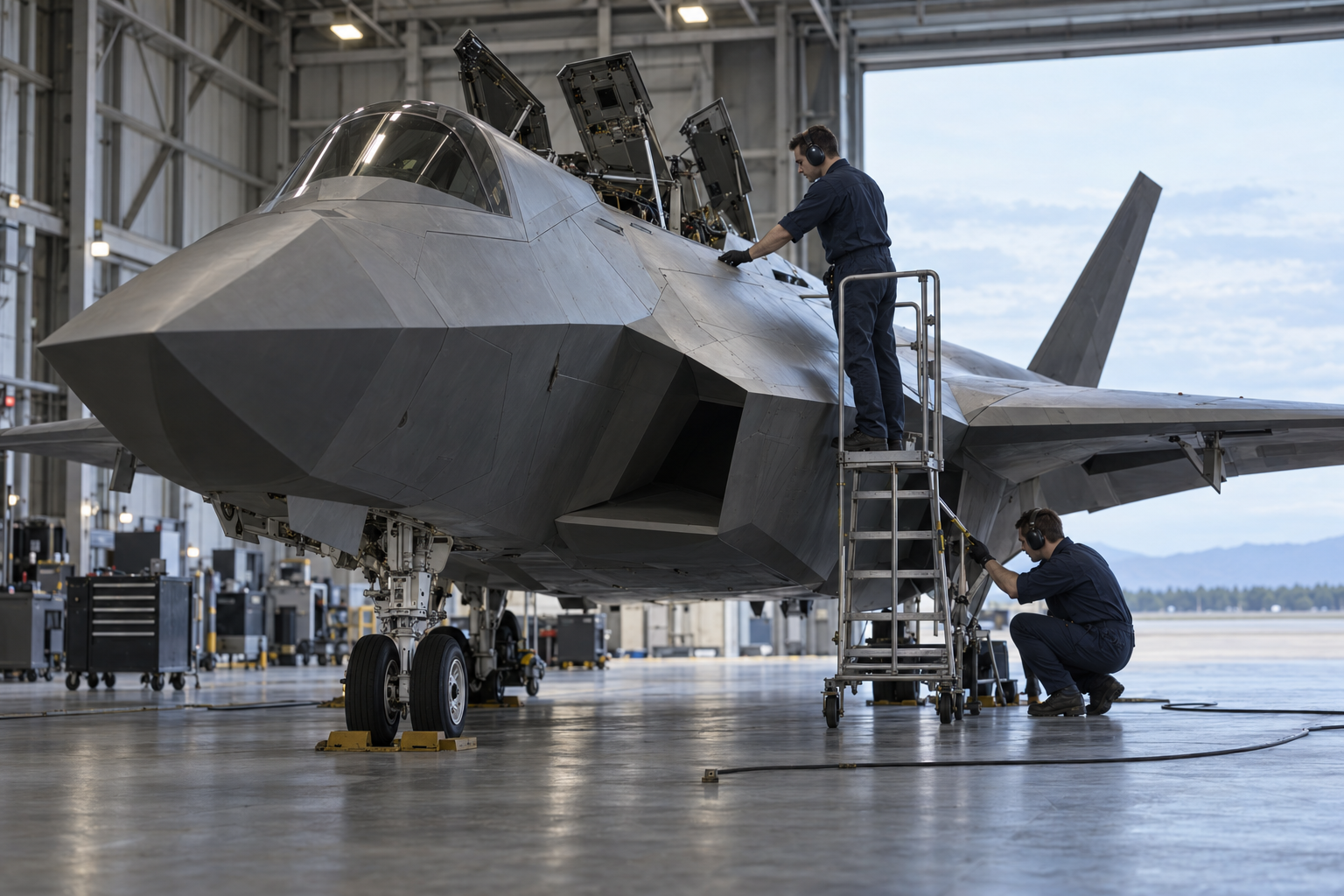
Most of the reduction comes from geometry. Aligned edges, serrated panel seams, blended wing-body shapes and buried engine inlets deflect energy away from the emitter rather than absorbing it. Radar-absorbent coatings handle the leftovers, mainly surface currents and seam leakage.
That split explains the maintenance bill. Shaping is free once the airframe is built. Coatings degrade in rain, heat and ground handling, and they need climate-controlled hangars and recurring inspection. An air force that buys the airframe and skips the hangars ends up flying a conventional aircraft at a stealth price. The physics behind both effects is set out in the reference on radar cross-section.
Frequency decides who sees you
Low-observable shaping is tuned against the centimetric bands that fire-control radars use, roughly C, X and Ku. Metre-wave VHF and UHF radars behave differently: when the wavelength approaches the size of the airframe’s features, shaping loses much of its advantage and resonance effects return part of the signal.
VHF radars pay for that with poor angular resolution, so they can tell a defender that something is out there without telling a missile where to go. The practical answer is pairing: a long-wave radar cues a search, a fire-control set refines it. Multi-static receivers and passive sensing push the same way, which is why the contest increasingly runs through electronic warfare rather than through raw radar power.
What stealth actually buys
- A shorter engagement window. The defender gets fewer seconds between detection and weapon release.
- Fewer shot opportunities per pass, which drains an interceptor inventory slower but also leaves the attacker less exposed.
- Freedom to carry weapons internally without the signature penalty of external pylons.
- Tolerance for operating closer to an emitter before being handed to a shooter.
- No protection at all against infrared search and track, visual detection, or the aircraft’s own radio emissions.
The last item is the one most often forgotten. An aircraft that talks constantly on a data link advertises itself regardless of its RCS, which is why emission control doctrine matters as much as the airframe.
Geometry still beats coatings
Detection is a line-of-sight business before it is a signature business. A sensor sitting 30 metres above sea level cannot see a low-flying target beyond its own geometric horizon no matter how reflective that target is, the same limit that shapes the naval detection problem. Altitude, terrain masking and route planning remain cheaper signature reduction than any coating.
When assessing a stealth claim, ask three questions: against which radar band, from which aspect angle, and carrying what. An answer that skips all three is marketing.
More articles you may like
- Air defence rarely fails on accuracy. It fails when the magazine runs empty
- A warship’s real enemy is the horizon, not the missile
- The battle you cannot see: how electronic warfare decides who wins first
- Loitering munitions: the weapon that waits before it strikes
- Precision-Guided Munitions: What “Smart” Weapons Actually Buy on the Battlefield
- The missile does not care about the target. The launcher decides everything