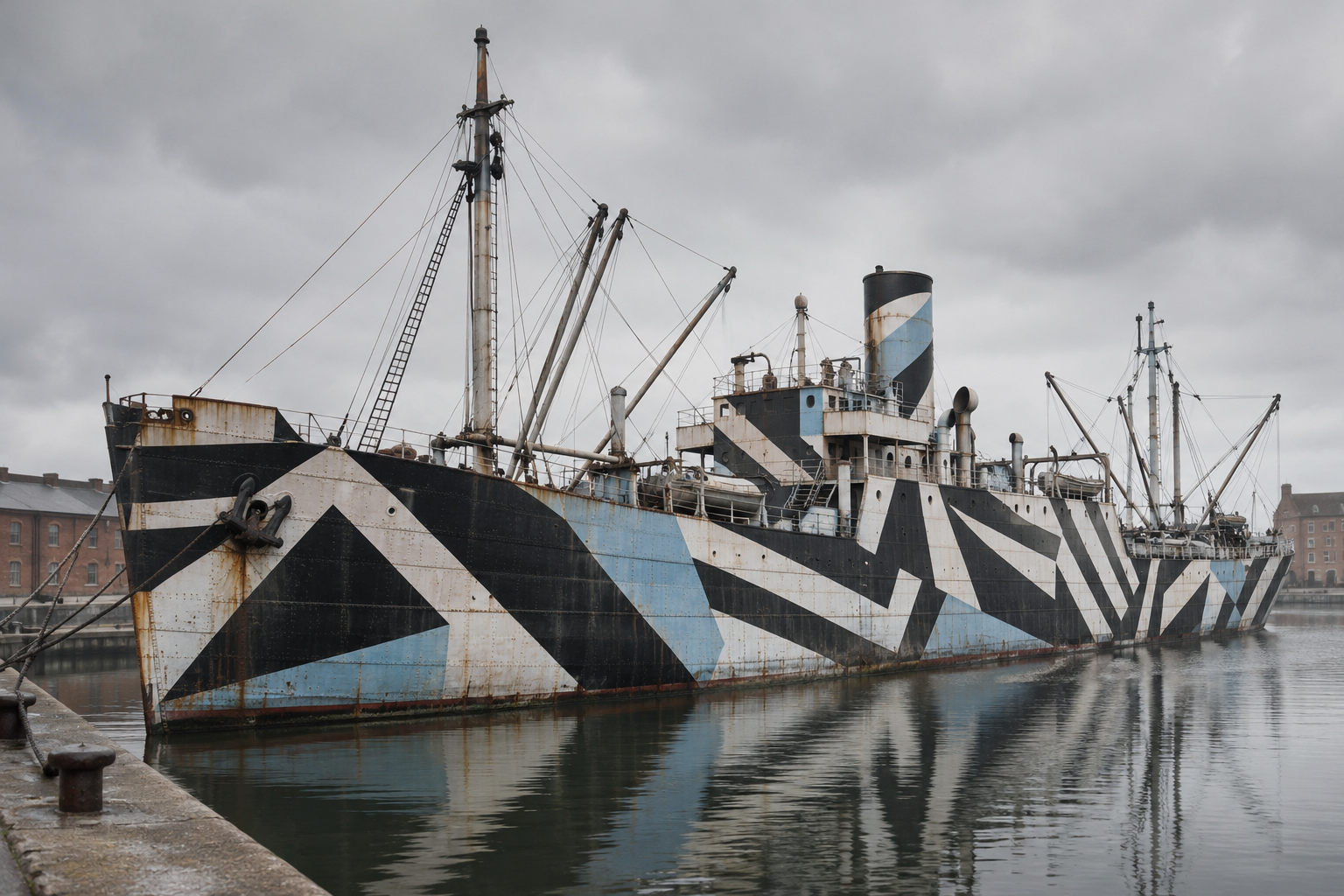
In short: Dazzle camouflage never tried to hide a ship. Its zigzag stripes were meant to confuse an observer about a vessel’s speed, size and heading. Britain and the United States painted thousands of ships this way in 1917-1918, yet the data on whether it worked stayed murky.
Ask most people what camouflage does and they will say it hides things. Look at a First World War photo of a cargo ship covered in black, white and blue zigzags and the idea collapses. Those ships were the most visible objects on the sea. That was the point.
Read also: The safest boat for checking a suspicious vessel is the one with nobody aboard · In a modern dogfight, the jet no longer has to point at the enemy · The cheapest weapon on the battlefield is a tank that does not exist
An artist’s answer to a submarine problem
By 1917 German U-boats were sinking Allied merchant ships faster than shipyards could replace them. Hiding a hull at sea proved close to impossible, because light, weather and the colour of the water changed by the hour. The British marine artist Norman Wilkinson, then a naval reserve officer, proposed a different goal: let the enemy see the ship, but make it hard to read.
A submarine commander looking through a periscope had seconds to judge where a ship was going and how fast. Bold, intersecting shapes broke up the line of the hull, so bow and stern blurred together. Wilkinson wrote in 1919 that he wanted to push the enemy into a poor attack position. Much like stealth does not make an aircraft invisible, dazzle aimed at the observer’s judgment, not his eyesight.
He was not first. The zoologist John Graham Kerr had written to Winston Churchill in 1914 suggesting patterns based on zebras and giraffes. The Admiralty rejected Kerr’s ideas in 1915 and kept its ships grey. Two years later it backed Wilkinson.
A studio full of art students
The Admiralty gave Wilkinson almost no facilities. A sculptor arranged studio space at the Royal Academy in Burlington House, and Wilkinson filled it with artists and students in naval uniform. They painted small wooden models, set them on a turntable and studied them through a periscope.
Every ship got its own pattern. Shared designs would have let the enemy recognise a whole class of vessels at a glance. The Vorticist painter Edward Wadsworth supervised the painting of more than 2,000 ships and later turned the work into a series of canvases. Picasso claimed the Cubists had invented the look first.
Did it actually work?
Nobody could prove it. In 1918 the Admiralty compared losses and found mixed results. The trouble is obvious once you see the numbers side by side.
Dazzle ships were attacked a little more often and survived a little better. They were also far bigger on average, which muddies every comparison. In the US, about 1,256 ships were painted between March and November 1918. Fewer than 1% of the dazzled merchant ships were lost, but without equivalent figures for plain ships the number proves little.
Where the stripes went next
Radar and aircraft made the idea far less useful in the Second World War, though some navies still used it. Deception moved elsewhere, toward things like a tank that does not exist. A ship’s crew also learned that its real limit at sea was distance: the horizon mattered more than paint once sensors could see past the human eye.
The look survived as design. Want to see it today? Try these:
- Liverpool’s 2014 Biennial repainted the pilot ship Edmund Gardner in Canning Dock with a dazzle scheme.
- Tobias Rehberger painted HMS President, moored by Blackfriars Bridge in London, for the same 2014 centenary programme.
- Manchester United released a dazzle-inspired kit for the 2020/21 season.
- Car makers still wrap test prototypes in swirling black-and-white patterns so photographers cannot read the body lines.
- Wadsworth’s painting “Dazzle-ships in Drydock at Liverpool” shows the original schemes in full colour.
The full record of the trials, the patents dispute and the artists involved is collected in the Wikipedia article on dazzle camouflage.
Next time you see a prototype car in zebra wrap on the highway, look at its doors and try to guess where the wheel arch ends. If you hesitate for a second, you have felt exactly what Wilkinson was selling in 1917.
More articles you may like
- The safest boat for checking a suspicious vessel is the one with nobody aboard
- In a modern dogfight, the jet no longer has to point at the enemy
- The cheapest weapon on the battlefield is a tank that does not exist
- Stealth does not make an aircraft invisible. It shortens the defender’s clock
- Air defence rarely fails on accuracy. It fails when the magazine runs empty
- A warship’s real enemy is the horizon, not the missile