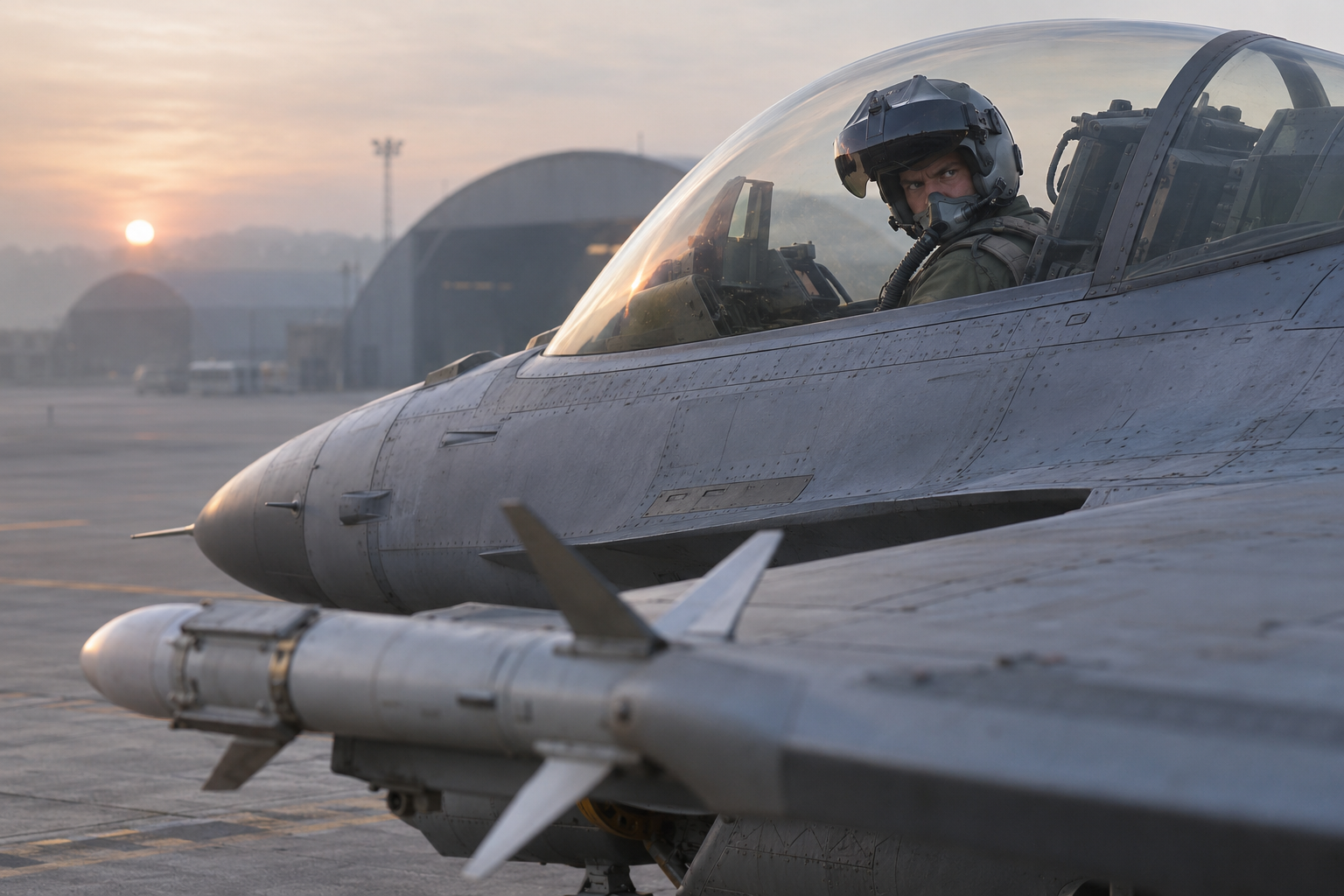
In short: Israel’s Python air-to-air missiles shifted the dogfight from flying skill to seeker and helmet technology. The Python-5 can lock onto a target after launch, even 100 degrees off the nose of the aircraft, so the pilot’s head matters more than the jet’s turning circle.
The classic picture of air combat is two fighters turning hard, each pilot trying to get behind the other. Whoever points the nose at the enemy first wins. That picture is about forty years out of date.
Read also: The cheapest weapon on the battlefield is a tank that does not exist · Stealth does not make an aircraft invisible. It shortens the defender’s clock · Air defence rarely fails on accuracy. It fails when the magazine runs empty
Rafael’s Python family shows how it broke. Each generation took one more job away from the airplane and handed it to the missile.
The early missiles needed the jet to do all the work
Israel’s first homegrown air-to-air missile, the Shafrir-1, entered service on Mirage jets in 1963. It performed so poorly that work on a replacement started almost at once. In the Six-Day War, Israeli pilots scored their kills with guns.
The Shafrir-2 fixed the reliability problem. During the 1973 Yom Kippur War, the air force launched 176 of them and destroyed 89 enemy aircraft, a hit rate close to one in two. That is remarkable for an infrared missile of that era. But it still had to be fired from behind the target, where the hot engine exhaust gave the seeker something to chase.
Then came the Python-3, with all-aspect capability. It could track a target from the front or the side, not just the tail. In the 1982 Lebanon War it was credited with 35 kills, and China liked it enough to license-build it as the PL-8.
The helmet became part of the weapon
The Python-4, which entered service in the 1990s, added something that changed pilot training: integration with a helmet-mounted sight. On Israeli F-15s and F-16s it works with the Elbit DASH helmet. The pilot looks at the enemy, and the missile seeker follows the pilot’s gaze.
That sounds like a gadget. It is not. It means the fighter no longer has to win the turning fight before it can shoot, a point that matters as much as the launcher deciding everything in ground warfare.
The Python-4 seeker reportedly also uses dual-band detection, infrared plus ultraviolet, to filter out decoy flares. A flare is hot, but it does not look like an aircraft in both bands at once.
Python-5: fire first, find the target later
The Python-5 went one step further. It carries an electro-optical and imaging infrared seeker that builds a picture of the sky rather than chasing a single hot spot. It is capable of lock-on after launch: the missile can leave the rail before it has seen the target, then search and lock on its own.
Combined with the helmet, this gives a pilot a target up to 100 degrees off the aircraft’s nose. That includes targets beside and partly behind the jet. Eighteen aerodynamic surfaces let the missile make the violent turn the airplane cannot.
Its first combat use came in the 2006 Lebanon War, when F-16s shot down two Iranian-made Ababil drones flown by Hezbollah. In May 2021, an Israeli F-16 used one to destroy a Hamas Shahed drone.
How the generations compare
What this means for how air combat is judged
If you want to understand a fighter’s real dogfight capability today, raw turning performance is a weak guide. Look at these instead:
- Which short-range missile it carries, and whether that missile can lock on after launch
- Whether the pilot has a helmet-mounted sight integrated with the weapon
- How well the seeker separates an aircraft from flares and background heat
- How quickly the radar or targeting sensors can cue the missile
The same logic explains why stealth shortens the defender’s clock: whoever detects and commits first usually decides the engagement. A missile that can be fired off-axis cuts that clock to seconds.
There is a ground-based twist too. Rafael’s SPYDER air defence system fires surface-launched versions of the Python-5 and the radar-guided Derby. The seeker that hunts fighters in a dogfight now also guards airspace from a truck, much like the broader shift toward precision-guided munitions on the ground.
The data in this article comes from the public record on the Rafael Python missile family on Wikipedia.
Next time you see a fighter comparison built on turn rates alone, check the missile column first. Since the Python-4, it has been the column that decides who goes home.
More articles you may like
- The cheapest weapon on the battlefield is a tank that does not exist
- Stealth does not make an aircraft invisible. It shortens the defender’s clock
- Air defence rarely fails on accuracy. It fails when the magazine runs empty
- A warship’s real enemy is the horizon, not the missile
- The battle you cannot see: how electronic warfare decides who wins first
- Loitering munitions: the weapon that waits before it strikes