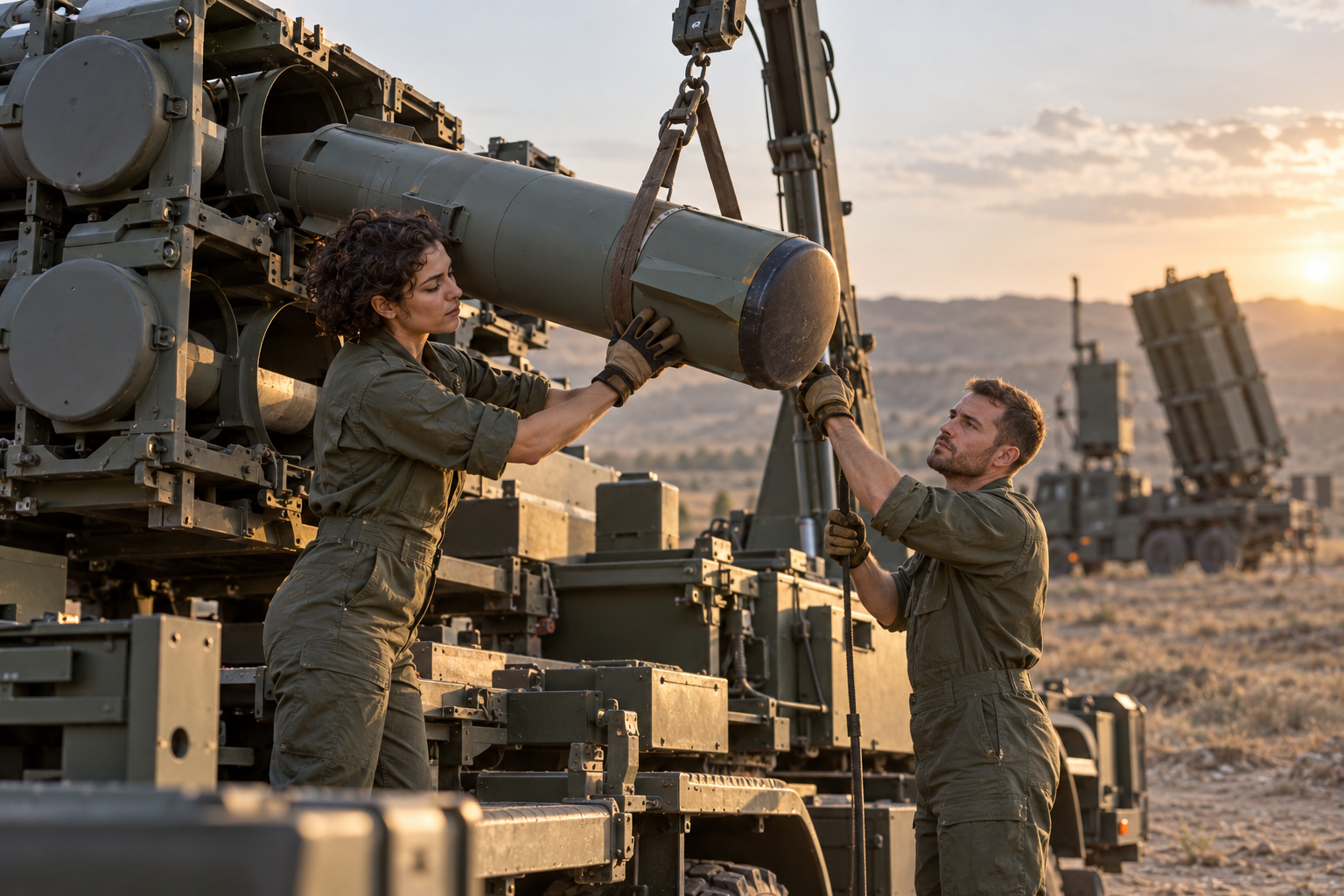
In short: modern interceptors hit what they aim at most of the time, so the real limit is how many rounds sit in the launcher and how fast they can be replaced. A battery with excellent hit probability and twenty rounds loses to a hundred cheap drones. Magazine depth and reload time decide the night, not the brochure numbers.
Ask most people what makes an air defence system good and they will talk about accuracy. Can it hit a ballistic target, can it track a low-flying cruise missile, what is the probability of kill per shot. Those questions were the hard ones in 1985. They are largely solved now, and the attacker knows it.
קראו גם: A warship’s real enemy is the horizon, not the missile · The battle you cannot see: how electronic warfare decides who wins first · Loitering munitions: the weapon that waits before it strikes
The attacker’s answer is arithmetic. If every incoming threat absorbs one or two interceptors, then the number of interceptors physically ready to fire is the ceiling on how long a defended site stays defended. Everything after that is a queue.
Salvo math is brutally simple
Air defence doctrine usually fires two interceptors at a serious threat, because a single shot leaves no margin if the first fails. An Iron Dome launcher publicly holds twenty Tamir interceptors. Under a two-per-target rule that launcher covers roughly ten engagements before someone has to physically bring more rounds.
Naval platforms look better on paper and worse in practice. An Arleigh Burke destroyer carries around 96 vertical launch cells, but those cells are shared between air defence, land attack and anti-submarine rounds. A commander who fills the ship with interceptors gives up strike capability, and the same launcher decisions that shape a ship’s offensive reach also cap its defensive endurance.
The cost exchange is the strategy
Cheap attack systems are not trying to win on performance. They are trying to make defence unaffordable, which is why loitering munitions keep appearing in volume rather than in quality.
Read the right-hand column twice. The defender spends more per engagement in almost every row, and the defender is the one who runs out of stock first.
Reloading is the part nobody films
Reload is measured in minutes to hours, not seconds. Land batteries need a crane vehicle, a resupply convoy and a crew working in the open during an active raid. Warships historically could not reload vertical launch cells at sea at all, which is why a destroyer that empties its magazine has to leave the fight and sail to a port.
What actually deepens a magazine
- Layered defence, so guns and short-range effectors absorb the cheap threats
- Soft kill through electronic warfare, which costs nothing per shot
- High-energy lasers, still limited by power and weather but effectively unlimited in rounds
- Cheaper interceptors built specifically against drones rather than against aircraft
- Networked sensors, so one battery does not waste two rounds on a target another unit already killed
Next time a new system is announced, skip the hit-probability slide. Ask how many rounds one launcher holds, how long a full reload takes, and what a single shot costs. Those three numbers tell you how long the system survives contact. For the engineering background on guided interception, the Surface-to-air missile overview is a solid starting point.
מאמרים נוספים שיעניינו אתכם
- A warship’s real enemy is the horizon, not the missile
- The battle you cannot see: how electronic warfare decides who wins first
- Loitering munitions: the weapon that waits before it strikes
- Precision-Guided Munitions: What “Smart” Weapons Actually Buy on the Battlefield
- The missile does not care about the target. The launcher decides everything
- Why interception, not thicker armor, keeps armored vehicles alive